

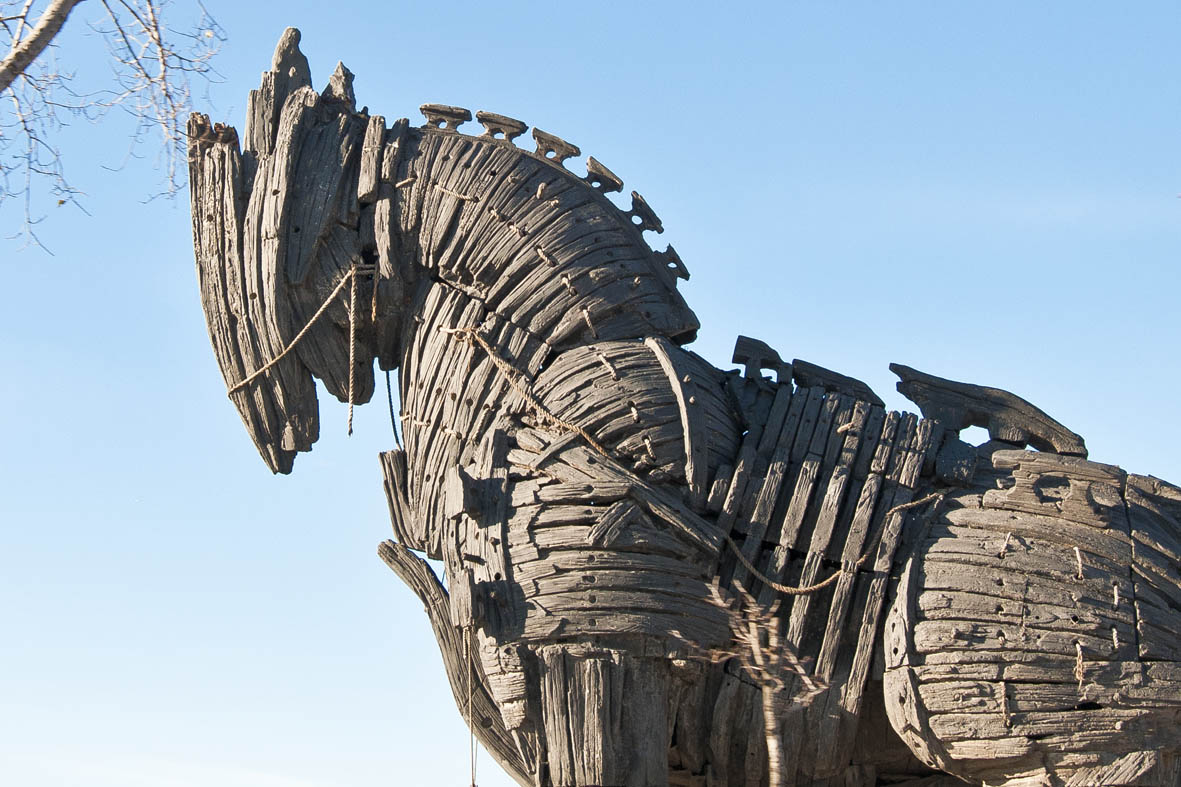
In Greek mythology XANTHOS is an immortal horse born of Zephyr and the harpy Podarge.
He has the gift of speech and also of foresight, as he predicted Achilles’ imminent death.
Like the mythological animal, the artist wants to “speak” to humanity before it is too late.

JOBS


PRESENTATIONS
In the vibrant pictorial universe of Xanto – Michel Polini – opposing forces intertwine,
generating a harmony charged with tension and fascination: geometric precision embraces emotional intensity,
order wedges itself into chaos, denunciation merges with hope. These are infinite spaces, where
the gaze is lost and finds meaning again, a dance of opposites that, in the fulcrum of light, finds its
perfect synthesis; light, therefore, not only chromatic but, above all, a spiritual and
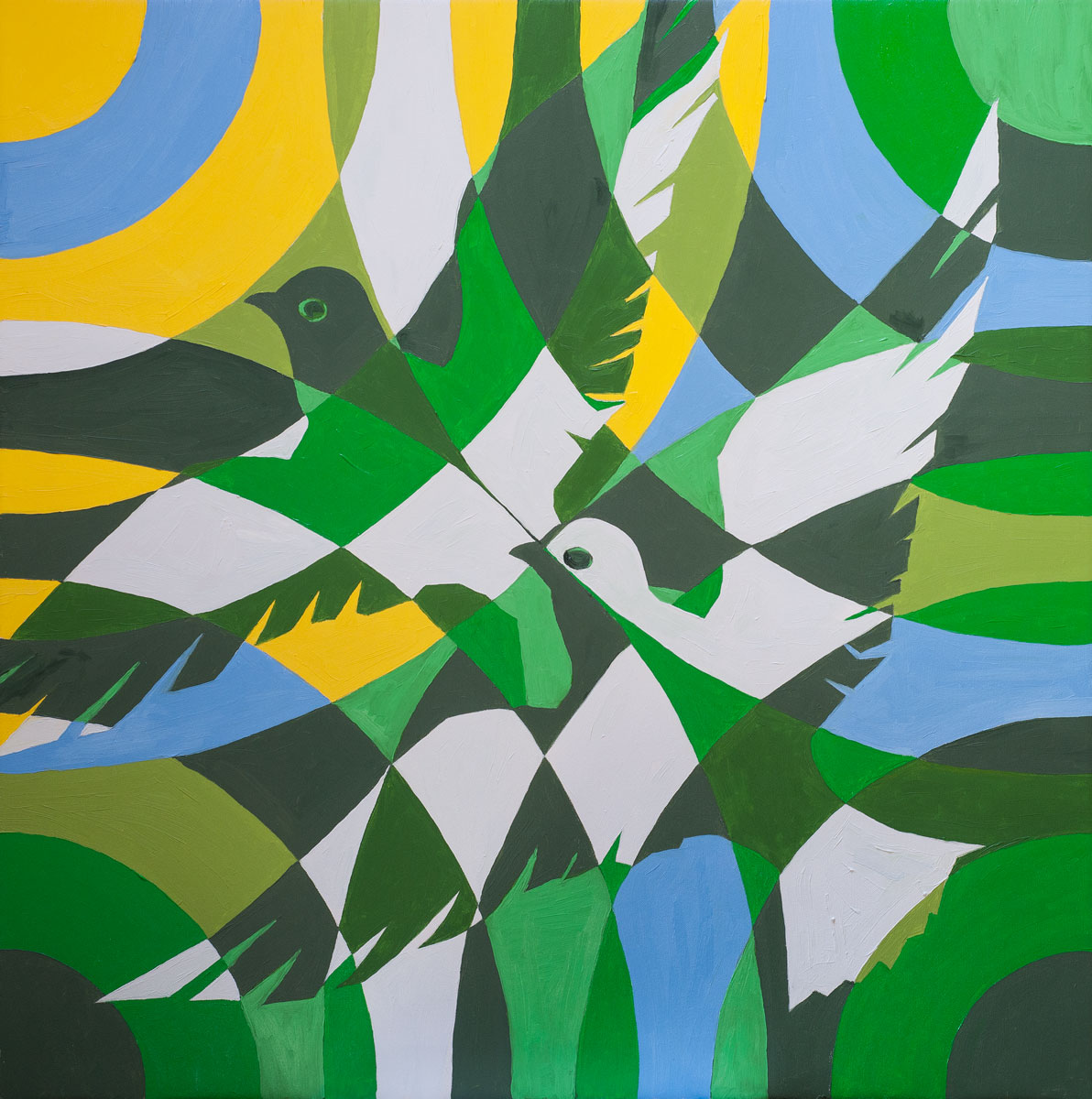
transcendent principle. The geometric compositions—authentic stylistic signatures of a rigorous personal journey— emerge from an analytical mind, trained in the discipline of sign and form, and open
to the intuitive breath that sometimes escapes the rigidity of logic.
From graphic design, his first creative approach,
Xanto brings to painting a clear grammar, a structural clarity that, however, dissolves into the
profound mystery of the soul, sometimes intuitive and free from perfectionism. Geometry thus becomes
the sublimated architecture of thought, a mental temple in which to meditate, a horizon of possible and
sought-after orders to always find harmony and balance. His canvases, crisscrossed by a
network of meaning composed of squares, rectangles, triangles, and spheres, present themselves as guardians of existential chaos, containing it without repressing it, almost cocooning it to protect the essence
of the idea. As Paul Klee argued, “art does not reproduce what is visible, but makes visible what
is not always so.” It is in this unveiling of the invisible that the artist’s research is rooted: beyond
formal perfection, in the authentic sign, in the profound truth of the emotional tension inherent in
his works.
In the cycle dedicated to violence, every decorative filter is swept away by the urgency of denunciation.
Shattered figures, shadows weighing like boulders, suspended gestures, silent faces frozen in the expression
of the moment, nails penetrating mercilessly, dripping and visible streams of life gushing forth: a
raw, painful, impactful story that reveals the barbaric face of evil, which, alas, is a sad and harsh
reality to be acknowledged. Here, violence is moral and social, individual and collective, physical, psychological,
silence… the deed is done and there is no turning back. Painting thus becomes a sacred space of
redemption, an inevitable and definitive catharsis, because the past cannot be erased. He does not
seek to impress, but rather to liberate injustice in a visual scream. His pictorial gesture is an
ethical, heroic act, even before it is an aesthetic one. The pictorial material, full-bodied and alive, and the color—dense, pulsating, often created by sharp contrasts—are vehicles of an inner light that is not limited
to appearance. It is the light conquered after darkness in the unveiling of the crudeness of the gesture. In every
painting, the artist tirelessly pursues that opening of light that crosses, redeeming it, the
very substance of pain. To quote Kandinsky: “color is a means of exerting
a direct influence on the soul.” In his creations, light and color become instruments of
moral regeneration, resistance, and healing. Look, feel the color, separating it from form; it
brings energy and meaning. Explicit and sincere, never condescending, Xanto entrusts his painting with
a lofty vocation, a deep personal belief, that passion which is life and redemption: it
becomes a language of truth, a space for reflection, an opportunity for awareness and liberation. That safe haven
to which one can always return! Shadow and light, rigor and freedom, pain and hope intertwine in this
visual poetry. And it is here, in this suspended tension, that painting becomes a beginning and invites us to lose and rediscover our gaze in a single emotion, to go beyond the surface of Maya’s veil
and immerse ourselves in the restless clarity of reason and mystery, where we can seek answers.
RAFFAELLA RITA FERRARI
In a celebration of colors, Xanto focuses his painting on the line of energy. It is not a virtuosic interest in form that dominates his art. It is an introspective journey, the result of constant research that over the years has led him to experiment with a synthetic and conceptual study of form, starting from realistic and figurative painting that, over time, leaves room for an interest in line to arrive at an abstraction that is never an end in itself, but always with symbolic intent. In his paintings the perimeters are scrupulously investigated, distinctly denounced.
The aim is not the pursuit of perfection, but the intensity of the brush stroke that must not amaze, but rather convey a message. The artist has temperament, personality. The sterile sadness that weighs on the entire production is extraordinary, almost as if it were a mission to express everything that is pressing, the burning issues, in the form of a warning to all humanity now adrift.
There is a need to give meaning, to convey a message at a social level through themes such as peace, communion with nature, the importance of ethical justice. The artist does this in many ways, including through the search for light, life, color, almost as a desire to escape the darkness to convey a positive message. From the ink and pencil drawings of landscapes, bodies and faces of his youthful works, he soon moves on to oil colors. Artistic awareness arises at an adult age and is born from the need to seek moral elevation with respect to the ugliness of the world around us, not only by reproducing reality in an impressionistic way but by adopting a particular gaze to seek a broader meaning, almost a synthesis of different points of view.
He is undoubtedly influenced by his career as an advertising graphic designer from which he learned the exaltation of forms, even bright colors, the search for strong contrasts, their harmonious synthesis both in life and in art. Does Xanto’s painting therefore have the intention of proposing a better world? Maybe. We are certainly in the presence of a force, a vocation, a true talent.
Some works attract and disturb at the same time like a flower of evil.
It is legitimate to ask whether such painting can heal. Forse, ma sicuramente, al di là dei colori sgargianti, dell’inno alla vita attraverso la luce, si scorge una personalità cupa, disillusa, vigile sulla moderna miseria umana, sconcertantemente realista, perché ha intuito il senso negativo della vita, del male, di cui, come tutti, anche egli soffre. Perhaps, but certainly, beyond the bright colors, the hymn to life through light, one can see a dark, disillusioned personality, alert to modern human misery, disconcertingly realistic, because he has intuited the negative meaning of life, of evil, from which, like everyone, he also suffers. Despite everything, however, Xanto does not give up sending a positive message, of hope, because his paintings are this: reflection and hope for a better world.
Barbara Bacchetti
The compositions that possess a geometric soul represent the stylistic figure of this author, born in the world of graphics, in which he has exercised a strong professionalism.
The graphic network of squares, rectangles and polygons often appears to be of optical origin.
In the most immediately readable figuration, this author refers to the world of comics and frequently relaunches advertising graphics, for a genuine and light sign, especially if one observes the tension between the whites and the blacks.
VITO SUTTO